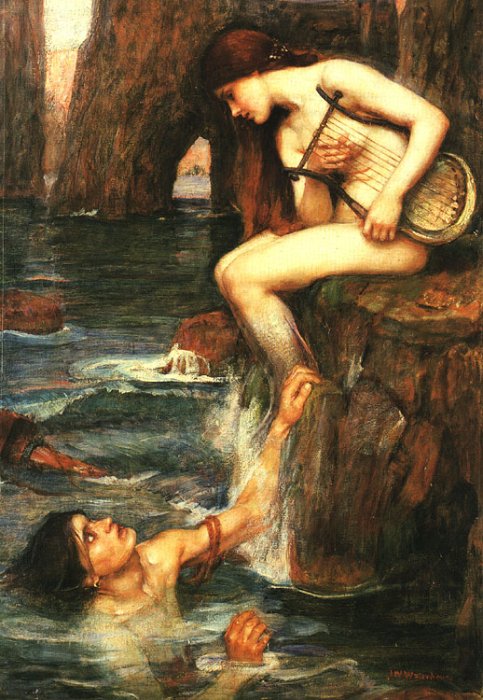
Her lips were red, her looks were free,
Her locks were yellow as gold:
Her skin was as white as leprosy,
The Night-mare LIFE-IN-DEATH was she,
Who thicks man's blood with cold.
The Night-mare LIFE-IN-DEATH was she,
Who thicks man's blood with cold.
A True Night-Mare
Samuel Taylor Coleridge (1772-1834)
The Rime of the Ancient Mariner (text of 1834)
The Rime of the Ancient Mariner (text of 1834)
-------------------------------------------------------------------------------------
I brought this point up on the discussion board the other day because I found it to be incredibly interesting. In Coleridge's poem, I was intrigued by the fact that death was represented by a woman. I was trying to think of any other plays or any peices of literature in which death was in the form of a female. Truly, I could not think of any.
I have always considered death as a more masculine figure. Consider the devil, who is male, and also the grim-reaper who has a masculine connotation. I desperately tried racking my brain, and despite everything I could think of, I have no recollection of a woman ever being death. I thought it was unique that Coleridge used a female to be the symbol of death.
But what does that mean? Is it simply coincidence or did Coleridge do this on purpose?
Once I went back and read the poem again, I picked up on several themes. I realized there was a need for redemption and appreciation of God's creatures. Through all of it, I could not find any reason for death to be a woman. Maybe Coleridge had a sexist view point of women? Or, maybe, to battle God (who is thought of as male) one would need a woman to oppose him (much like Eve).
I do remember, however, that in ancient mythology women were often associated with evil, power, and manipulation. Consider Medusa, or other such lady monsters that plagued the sea and created nightmares for sailors for centuries. (http://www.paleothea.com/LadyMonsters.html)
Also, I remember in the Pirates of the Carribbean, that the dress aboard the ship was considered bad luck. For some sailors, women were the ultimate curse when they were on board. This website (http://pacificoffshorerigging.com/nautical_superstitions.htm) points out several nautical supersitions and one of them is women being on board: they make the sea angry. Yet, naked women on board -- all good. Also, it taps in to the killing of an albatross and a gull - which contain the souls of sailors lost at sea.
Look at the sirens and the myth that women on board attracted sea monsters, dangerous seas and death. Maybe Coleridge took these historical ideas in to place when he wrote the poem.
Or...he could have just been sexists.
I just find it so interesting as to how history applies roles to women. In some myths, they are symbols of fertililty, forgiveness and creation and yet in others -- they are wicked, sex-driven, manipulators. I believe Coleridge swayed towards being a bit more sexist and also a bit supersitious.


No comments:
Post a Comment