
Thomas More
His Life, Works and More...
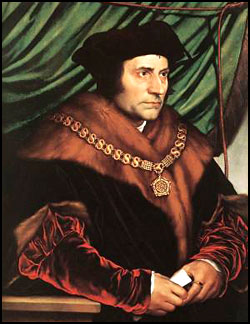
Thomas More was born in London to Sir John More on February 7, 1478. He was educated at St. .Anthony's School in London and later furthered his education by attending Oxford under Thomas Linacre and William Grocyn. During this period, More was writing countless comedies and also studied Greek and Lat
in literature.
But More wanted more and around 1494 More returned to London to study law and was admitted to Lincoln's Inn in 1496. The Inn is one of the oldest of the four Inns of court. It contains formal records that go back continuously to 1422. While at Lincoln's Inn, More decided to become a monk and subjected himself to the discipline of the Carthusians. For More, he lived the life of a month and the Catholic Encyclopedia describes it as "The Carthusian life is essentially solitary and contemplative with a certain admixture of the cenobitic element (see I). A very large part of the day is devoted to saying the three Offices (i.e. that of the day, the Office of Our Lady, which is called de Beata, and the Office of the Dead), while much time is given to mental prayer. The rest is divided between manual labour, study, and a little recreation."
Yet, once again More makes a decision to change positions. In 1504, he entered Parliament and married for the first time somewhere between 1504 and 1505.
One of More's first acts in Parliament was to urge a decrease in a proposed appropriation for the King Henry VII. The King retaliated by imprisoning More's father and did not release him until a fine was paid and More withdrew from public life. But after the death of the King in 1509, More came out of hibernation.
The next king, Henry VIII, favored More. In 1515, More accompanied a delegation to Flanders to help with disputes about the wool trade. This is when Utopia comes to play and More actually uses the trip as a reference. Also, More helped in suppressing an uprising against foreigners and was portrayed in the play Sir Thomas More, which is rumored to have been done by Shakespeare. More also accompanied the King and court and in 1518 he became a member of the Privy Council. He was knighted in 1521.
In 1523 - he was made Speaker of the House of Commons and Chancellor of the Duchy of Lancaster in 1525. Then, after Thomas Wolsey fell in 1529, More became the Lord Chancellor and was the first layman yet to hold the post.
It was in 1523 though that More resigned. Although reasons are not clear, it is said to be either linked to ill health or More's disapproval of King Henry's behavior. In April, 1534, More refused to swear to the Act of Succession and the Oath of Supremacy and was sent to the Tower of London on April 17th. He was then found guilty of treason and was beheaded alongside Bishop Fisher on July 6, 1535. More's final words were: "The King's good servant, but God's First."
--- works of thomas more ---
CW1. English Poems. Life of Pico. Last Things.
CW2. Richard III (also paperback).
CW3. I. Lucian Translations. II. Latin Poems.
CW4. Utopia (also paperback).
CW5. Responsio ad Lutherum.
CW6. Dialogue Concerning Heresies.
CW7. Letter to Bugenhagen, Supplications of Souls, Letter against Frith.
C8. Confutation of Tyndale's Answer.
C9. Apology of Sir Thomas More.
C10. Debellation of Salem and Bizance.
C11. Answer to a Poisoned Book.
C12. Dialogue of Comfort (also paperback).
CW13. Treatise upon the Passion, Treatise on the Blessed Body, Intructions and Prayers.
CW14. De Tristitia Christi (also paperback).
CW2. Richard III (also paperback).
CW3. I. Lucian Translations. II. Latin Poems.
CW4. Utopia (also paperback).
CW5. Responsio ad Lutherum.
CW6. Dialogue Concerning Heresies.
CW7. Letter to Bugenhagen, Supplications of Souls, Letter against Frith.
C8. Confutation of Tyndale's Answer.
C9. Apology of Sir Thomas More.
C10. Debellation of Salem and Bizance.
C11. Answer to a Poisoned Book.
C12. Dialogue of Comfort (also paperback).
CW13. Treatise upon the Passion, Treatise on the Blessed Body, Intructions and Prayers.
CW14. De Tristitia Christi (also paperback).
--- utopia ---
Utopia can be described as a critical examination of contemporary English institutions and customs. More was inspired by his close friend Erasmus and by ancient thinkers Plato and Aristole. He applied humanists philosophies and created his own utopian society. Literature Network described Utopia beautifully: "Utopia is a classic masterpiece that conveys More's vivid imagination of the Island of Utopia. Although most of the characters are fictional, it is intriguing to learn about the true values of European societies during the 16th century, when More actually wrote the book (although many scholars believe that the exact year was 1515). Truthfully, the book is quite easy to understand. All More tries to do is convey his own views of how society should be through Raphael. Moreover, the use of imagery in Book I is quite fascinating, including the constant references to Roman and Greek myths and beliefs."

... More's Utopia ...
---------------------------------------------------------------------

... m y -- u t o p i a ...
---------------------------------------------------------------------
websites:
This website had a majority of the information that I used. I read this one thoroughly first and used it for my reference source. All of the info was very clear and easy to read -- it never made it tedious. I definitely used this one the most as it gave other sites to check out plus essays, articles, etc. Overall - very helpful.
This had the information about Lincoln's Inn. I didn't want to just write it without knowing what it was so I checked it out here. This was the website link given on the page to check out so I simply followed the hyperlink.
I got the information about the Carthusian Order from this website. I really didn't know anything about it but I ended up reading a lot from this page. It made a lot of sense, especially when applied to More's life and opinions.
I even quoted this one! I thought the information on here was clear and concise. Sometimes reading about history and things like this can really drag on but I appreciated how breif it was. It made getting through it much easier and I was able to use a great quote about Utopia.
Just like Sparknotes but with more outlets. I was able to follow more links and read alot more about Thomas More and Utopia. It had links to common themes, chapter I and II summaries and unlocked alot of the topics that I previously wasn't that clear on.
This is the website were I was able to pull the complete collection of works. Although it didn't have any information on it, I thought it would be great to use. I liked being able to look at all the differents peices of literature that More had produced.
Same site -- different information. This one was all about More, his life and his works. It was a lot like the first website and I was able to bounce different facts off of either website.
Can you blame me? It had SO much information and I really couldn't help myself. At least it isn't wikepedia! I know the information is accurate but I always feel like using Cliffnotes/Sparknotes is the 'easy-way-out' for not reading the book but thankfully, I did so...I don't feel bad. I was able to use this website as a reference and it had a lot of info about Thomas More's other works.


No comments:
Post a Comment