Wednesday, February 27, 2008

oh! more othello!

Tradegy of
Othello
the moor of venice


"O, beware my lord, of jealousy!

It is the green-eyed monster..."


[iago--3.3.195-96]


--------------------------------------------------------------------


Prior to my paper I was dreading this blog. I really could not think of anything that was an important aspect of Othello until I truly made myself think about it. And then it hit me...duh! Jealousy! I felt that was a huge part of this play as it was what propelled it and created the twisted and unthinkable plot. It was the green-eyed monster that created catastrophe and ripped away the lives and reputations of the honest and good. Othello fell victim to its poison, Roderigo played the fool because of it and Iago behaved the way he did all because of one disgusting element; jealousy. It was the unifying theme that brought down a strong leader, destroyed a relationship and allowed the wicked to get the last word and laugh.


I decided to analyze the relationships and how jealousy played off of each of them.


Consider: Roderigo and Othello, Cassio and Othello and lastly of Iago and Cassio


“It is silliness to live, when to live is to torment, // and then have we a prescription to die when death is // our physician,” (I, iii, 350-52).


Poor Roderigo...he never saw it coming. This quote is not only depressing but it is also foreshadowing the events to come. It was tough to read about how much this silly young man adored this woman and saw nothing else but death if he could not have her. Maybe he would have been the better man for her and yet, I am sure Iago would have recognized how weak he was and would have eaten him alive.


Roderigo was consumed, however, by the green eyed monster. He could not think of anything else but how much he wanted Desdemona. Roderigo continued to fuel Iago's plan by supplementing him with jewels and money and yet, got nothing in return. "With naught but truth. I have wasted my // self out of my means. The jewels you have had // from me to deliver [to] Desdemona would half have // corrupted a votaress. You have told me she hath // recieved them, and returned me expectations and // comforts of sudden respect and acquaintance, but I // find none," (IV, ii, 216-222). It is so sad to see Roderigo broken like this, desperately trying to buy his love from Desdemona. He is willing to give everything he has and also attempt to murder in search for love.


That is where jealousy finds its foundation for corruption. For Roderigo, he is willing to follow Iago to get to the one thing he wants: Desdemona. It appears that the green eyed monster has devoured Roderigo's sense of morality. Much like Iago, Roderigo will stop at nothing to get at Othello. He is definitely Iago's puppet and because of jealousy towards Othello and his desire for Desdemona, he follows Iago's every command.


It is a shame as to what jealousy can do to a man, or woman for that matter. Yet, in "Othello", it was men that were being attacked. In today's society, you hear on the radio, television and even read in the magazines about crazy ex girlfriends. Yet, Othello was the INSANE jealous husband.


"Ay, let her rot and perish and be damned // tonight, for she shall not live. No, my heart is turned // to stone. I strike it, and it hurts my hand. O, the world hath not a sweeter creature! She might lie by an emperor's side and command him tasks." (IV, i, 200-204).


Ouch. Ouch. Ouch. There was definitely a sting to that one. I believe it was at this point that Othello truly snapped. No longer was Desdemona the woman of his dreams, she was a nightmare that represented hate and infidelity. In his mind, there was nothing else to do but kill her. "Get me some poison, Iago, this night. I'll not // expostulate with her lest her body and beauty // unprovide my mind again. This night, Iago." (IV, i, 223-225).


Yet where does all of this anger come from? Othello's rage stems from his jealousy towards Cassio. Had it not been for Iago planting the seed, I am sure Othello would never had turned on his good friend. It is a shame what jealousy can do to a friendship and how it can annihilate any ounce of trust someone originally had. For Othello, his friendship was ruined. He became jealous of Cassio without any true facts. He never questioned Iago and quickly fell in to his trap. The green eyed monster had its way with Othello and devoured his heart in one gulp.


The story would never have occured had it not been for Iago's jealousy towards Cassio. This is where it all begins...when Iago loses control and becomes dedicated to ruining those around him. "Despise me // If I do not. Three great ones of the city, // In personal suit to make me his lieutenant, // Off-capped to him; and, by the faith of man, // I know my price, I am worth no worse a place." (I, i, 8-12).


This whole story would have been nothing had it not been for Iago. I was really disgusted by his personality and how corrupt he was. Yet, Iago is jealous not just of Cassio but also of Othello. The secret assumption that Othello has slept with Emilia drives his rage even further. " I hate the Moor, // And it is thought abroad that 'twixt my sheets // 'Has done my office. I know if 't be true, // But I, for mere supicion in that kind, // Will do as if for surety. He holds me well. The better shall my purpose work on him // Cassio's a proper man. Let me see now: To get his place and to plume up my will // In double knavery -- How? how? -- Let's see," (I, iii, 429-437) From that passage on, Iago begins his raid on those around him. Had it not been for jealousy, he would probably never have snapped.


"...one that loved not wisely, but too well," (V, ii, 404).


Yet, the emotion was too strong to overcome and the weakest man led to the destruction of the strongest general. Iago definitely exploited Othello, his reputation and his dignity as he drove the man to the verge of murder and suicide. It was not Iago as he was simply the conductor for the current of jealousy. It was the emotion that erupted from Iago, Othello and Roderigo that caused each of their downfalls. The green-eyed monster was originally Iago’s puppet until it eventually ran rampant and consumed all of those around. No one, not even a great soldier, can be spared the wrath of jealousy. It is an undeniable fact of reality and as long as it exists, it will continue to blind those who fall beneath its power – regardless of race, gender and even time period. There is simply no stopping envy.


Monday, February 25, 2008

the movie vs. the play


that movie was...h o r r i f y i n g


i have to give the movie credit -- i felt it was very closely tied to othello's original plot. it managed to mix modern twists in to a play that had been written thousands of years ago. it is unbelievable that Shakespeare's writing is so timeless and can be adapted for any generation. honestly, though, i didn't think that the play was nearly as horrific as the movie.


maybe it was because the movie was visual and i was able to watch and study the characters. the play had great character development but it was much easier for me to get sucked in to the movie than it was the book. towards the end of the movie i caught myself with my jaw wide open and could not believe the plot was unfolding before me...and yet...i had already read the play...twice!

but...i felt that the movie played with the play's plot a little bit and tweeked it to fit modern society. i also thought that the continuous 'bird scenes' were a bit unneccessary and, even though it was symbolic, i got tired of it. i did like how the movie gave all of the characters similair names and their roles were easy to figure out.

my biggest problem with the movie was poor roger! i felt soooo bad for the kid. i felt the movie focused a lot of his weaknesses and drifted away from the fact that he was doing this for desdemona. it seemed to me that, in the movie, roger was more than just a tool for hugo but also a very important character. in the play, roderigo drifted in and out as needed by shakespeare. but, in the movie, he was more prevavalent and almost had more of a reason to kill for just desdemona -- it was to regain his reputation and his dignity. i hate to watch people pick on other people...and watching the basketball game scene was a bit upsetting. i felt bad for him, especially when he panicked and hugo ended up killing roger and michael. (i know in the play that roderigo died and cassio lived but in the movie...it definitely hinted that michael didn't make it).

overall, i thought the movie was pretty fantastic. it was pretty gruesome for me though. i was not expecting to be so surprised by the movie. i thought they did a great job in representing it and adapting it to current society. i thought the twist of drugs and oden's past was an interesting aspect. i really don't think it took anything away from the original version at all.

so if i were a movie critic i would say: A


Sunday, February 17, 2008

do i really want to know more about More?


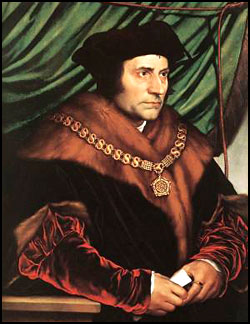
Thomas More


His Life, Works and More...


Thomas More was born in London to Sir John More on February 7, 1478. He was educated at St. .Anthony's School in London and later furthered his education by attending Oxford under Thomas Linacre and William Grocyn. During this period, More was writing countless comedies and also studied Greek and Lat


in literature.


But More wanted more and around 1494 More returned to London to study law and was admitted to Lincoln's Inn in 1496. The Inn is one of the oldest of the four Inns of court. It contains formal records that go back continuously to 1422. While at Lincoln's Inn, More decided to become a monk and subjected himself to the discipline of the Carthusians. For More, he lived the life of a month and the Catholic Encyclopedia describes it as "The Carthusian life is essentially solitary and contemplative with a certain admixture of the cenobitic element (see I). A very large part of the day is devoted to saying the three Offices (i.e. that of the day, the Office of Our Lady, which is called de Beata, and the Office of the Dead), while much time is given to mental prayer. The rest is divided between manual labour, study, and a little recreation."


Yet, once again More makes a decision to change positions. In 1504, he entered Parliament and married for the first time somewhere between 1504 and 1505.


One of More's first acts in Parliament was to urge a decrease in a proposed appropriation for the King Henry VII. The King retaliated by imprisoning More's father and did not release him until a fine was paid and More withdrew from public life. But after the death of the King in 1509, More came out of hibernation.


The next king, Henry VIII, favored More. In 1515, More accompanied a delegation to Flanders to help with disputes about the wool trade. This is when Utopia comes to play and More actually uses the trip as a reference. Also, More helped in suppressing an uprising against foreigners and was portrayed in the play Sir Thomas More, which is rumored to have been done by Shakespeare. More also accompanied the King and court and in 1518 he became a member of the Privy Council. He was knighted in 1521.


In 1523 - he was made Speaker of the House of Commons and Chancellor of the Duchy of Lancaster in 1525. Then, after Thomas Wolsey fell in 1529, More became the Lord Chancellor and was the first layman yet to hold the post.


It was in 1523 though that More resigned. Although reasons are not clear, it is said to be either linked to ill health or More's disapproval of King Henry's behavior. In April, 1534, More refused to swear to the Act of Succession and the Oath of Supremacy and was sent to the Tower of London on April 17th. He was then found guilty of treason and was beheaded alongside Bishop Fisher on July 6, 1535. More's final words were: "The King's good servant, but God's First."


--- works of thomas more ---


CW1. English Poems. Life of Pico. Last Things.
CW2. Richard III (also paperback).
CW3. I. Lucian Translations. II. Latin Poems.
CW4. Utopia (also paperback).
CW5. Responsio ad Lutherum.
CW6. Dialogue Concerning Heresies.
CW7. Letter to Bugenhagen, Supplications of Souls, Letter against Frith.
C8. Confutation of Tyndale's Answer.
C9. Apology of Sir Thomas More.
C10. Debellation of Salem and Bizance.
C11. Answer to a Poisoned Book.
C12. Dialogue of Comfort (also paperback).
CW13. Treatise upon the Passion, Treatise on the Blessed Body, Intructions and Prayers.
CW14. De Tristitia Christi (also paperback).


--- utopia ---


Utopia can be described as a critical examination of contemporary English institutions and customs. More was inspired by his close friend Erasmus and by ancient thinkers Plato and Aristole. He applied humanists philosophies and created his own utopian society. Literature Network described Utopia beautifully: "Utopia is a classic masterpiece that conveys More's vivid imagination of the Island of Utopia. Although most of the characters are fictional, it is intriguing to learn about the true values of European societies during the 16th century, when More actually wrote the book (although many scholars believe that the exact year was 1515). Truthfully, the book is quite easy to understand. All More tries to do is convey his own views of how society should be through Raphael. Moreover, the use of imagery in Book I is quite fascinating, including the constant references to Roman and Greek myths and beliefs."


... More's Utopia ...


---------------------------------------------------------------------


... m y -- u t o p i a ...
---------------------------------------------------------------------
websites:
This website had a majority of the information that I used. I read this one thoroughly first and used it for my reference source. All of the info was very clear and easy to read -- it never made it tedious. I definitely used this one the most as it gave other sites to check out plus essays, articles, etc. Overall - very helpful.
This had the information about Lincoln's Inn. I didn't want to just write it without knowing what it was so I checked it out here. This was the website link given on the page to check out so I simply followed the hyperlink.
I got the information about the Carthusian Order from this website. I really didn't know anything about it but I ended up reading a lot from this page. It made a lot of sense, especially when applied to More's life and opinions.
I even quoted this one! I thought the information on here was clear and concise. Sometimes reading about history and things like this can really drag on but I appreciated how breif it was. It made getting through it much easier and I was able to use a great quote about Utopia.
Just like Sparknotes but with more outlets. I was able to follow more links and read alot more about Thomas More and Utopia. It had links to common themes, chapter I and II summaries and unlocked alot of the topics that I previously wasn't that clear on.
This is the website were I was able to pull the complete collection of works. Although it didn't have any information on it, I thought it would be great to use. I liked being able to look at all the differents peices of literature that More had produced.
Same site -- different information. This one was all about More, his life and his works. It was a lot like the first website and I was able to bounce different facts off of either website.
Can you blame me? It had SO much information and I really couldn't help myself. At least it isn't wikepedia! I know the information is accurate but I always feel like using Cliffnotes/Sparknotes is the 'easy-way-out' for not reading the book but thankfully, I did so...I don't feel bad. I was able to use this website as a reference and it had a lot of info about Thomas More's other works.

wife of bath...what kind of woman was she?


Wife of Bath
what would she really have been?
what side of the spectrum would she have been on?


aaaaaaaaaaaaaaaaa

I feel like I am extremely behind in this class because my blog for the WoB is just now being completed. Maybe I'm the bad person for procrastinating as much as I did on this particular blog but...before I begin wasting time again...these are my thoughts of the WoB. I must ignore the beckoning Myspace and Facebook and actually be productive.
--- aaaaaaaaaaaaaaaaaaaa ---

Geoffrey Chaucer's Wife of Bath is an elaborate tale of an independent, determined and potentially disagreeable woman. The main character, the Wife of Bath, is undoubtedly a fiesty creation that resembles women of our current society. She is ferocious in her look for love, confindent in her ability to manipulate every man she attracts andseemingly fearless. Yet, when attempting to break through her tough exterior, Chaucer is vague in describing her true person. The reader is left to interpret her harshness, her lustfulness, as well as her overall character as they please. Fortunately, I was amused by the Wife of Bath. Although I do believe she was somewhat immoral, she was definitely that deserved a little bit of recognition, if not respect. I appreciate the WoB's spirit, her determination and lastly her sense of self.


If there was a scale based on morality of character, the WoB might score somewhere around where our modern day Paris Hilton might end up. Unfortunately, is appears that women with these certain personality traits become timeless parts of every society. Much like Miss Hilton, the WoB was a wealthy woman who was fortunate enough to know the tricks of the trade. The WoB was very capable of getting everything her way and often prided herself on it. In her prologue she states, "And whan that I have toold thee forth my tale // Of tribulaciun in marriage, // Of which I am expert in all mine age -- // This is to saye, myself have been the whippe --" (lines 172-175).

But, is this a negative quality? Women in our current society must mock the attributes of a succesful man. Generally speaking, it requires a woman to be more assertive as well as demanding. Although the glass is slowly beginning to crack, the ceiling still does exist. I believe that if the WoB would have existed in our current day and age she would have been one step closer to becoming a money mogul much like Oprah but with an edgy, Madonna, Hilton and Donald Trump edge. For this, I like the WoB's fiestyness as well as her openess in admitting to her flaws. She is obviously confident and, for that reason, I like her just a little bit more.

The WoB was definitely more than just full of, well, piss and vinegar. (I know that term is somewhat...vulgar...but I felt it described her quite well). She was confident in herself both physically and mentally. She was well educated and was obviously interested in exploring (hence the reason for the pilgramige and others). She had probably been trained the way of a lady and, throughout all of her marriages, was more than accustomed to the life of a wealthy woman. Her confidence was maybe the most amusing aspect of the WoB. I believe it was this particular quality that allowed me to overlook her other habits. I tend to regard characters highly when they themselves do the same. Confidence is contagious and, with literature, a reader can somewhat morph in to character and draw out the qualities they appreciate the most.
I believe that the WoB deserves respect because of her willingness to bear her soul. She is confident inthe Prologue to her tale and she was definitely the dominating factor. She refused to allow interruptions and occasionally was a bit brazen in her manner. In admitting to her weaknesses and telling of her past marriages, she hits on one theme that, according to Bruce Magee's notes on the Wife of Bath (http://www2.latech.edu/~bmagee/201/chaucer/wife_notes.htm), deems her as being "bad". Magee's notes read, "The WOB [is] considered bad because she follows desire." Although true, I don't think that because she is a 'go-getter' type of girl she is automatically bad. But, I understand that Magee's approach was from society then and not now. Had her story and her attitudes been adapted to current society, the fact she follows her desires would be something no one would notice because almost everyone does it.


The WoB, much like the roses named for her, are a tenacious breed notorious for their beauty and their thorns. She was very much aware of the person she was and the type of rebel she was for her time. Chaucer allowed her to indulge herself as well as amuse herself when describing who she was the other pilgrams. In her prologue she says, "As help me God, I was a lusty oon, // And faire and riche and yong and well bigon. // And trewely, as my housbondes tolde me, // I hadde the beste quoniam mighte be," (lines 605-608). The WoB is very concious of her good looks and flaunts them. She has had many years of playing the role of a foxy vixen and I don't think she ever wants to give that up, regardless of age or maritial status. I would never say I look to her for inspiration but I do admire how she accepts herself completely, even if it is a bit arrogant. Regardless, she is definitely a strong woman and that is something to give credit to.
Overall, I believe the WoB lacks a few morals but makes up for them in confidence and honesty. She is open minded and willing to accept the criticism of others for the person she is. She is happy with what she has become and has struggling through several unsuccesful marriages. After being married at 12, I would have to say she is definitely a survivor. Chaucer's WoB is an amusing and interesting character -- especially because she is so foreign to the time period in which she was set. What makes this ironic is that, unbeknownst to Chaucer, the WoB is a timeless figure that represents alot of the women of today. Is she good? I believe so yes. She sins, but accepts it and appears to be optimistic. She has not committed any crimes and, in my book, I would say that the WoB deserves a bit of what she gets but...for what she is and what she stands for...she is still a good woman.
--------------------------
websites:
An outline of Geoffrey Chaucer, the time period and offers insight in to relationships and relates it back to the Wife of Bath. It was very interesting and provided for a very good quote.
I believe this was one of the websites that was given as a good reference in the class. It had a lot of different links that I was able to branch off on. I am surprised as to how much time I spent on here. I really like this link though because of everything it had on there -- no wonder it was a reference!
Much like the last one, this had many links to go and look at. I think I actually found the first one off of this particular 'mother' site. It had pictures, and sooo much information I did not know what to do with myself.
------- heads up -------
again - i redid this one. i never changed the text just added the websites and went over the format.

chaucer and his middle aged women...

"Truth is the highest thing that man may keep."
Canterbury Tales. The Frankeleines Tale. Line 11789


Chaucer is considered one of literature's most influential and oustanding figures. In a time way before Shakeaspeare, Chaucer was "the first finder of our language" (Encyclopedia Britannica Online, "Geoffrey Chaucer). Born somewhere between 1342 and 1343, Chaucer first appears in the records around 1357. Working in the household of Elizabeth, the countess of Ulster, he was able to work in a royal household and gain experience in royal and court like settings.

From there Chaucer dabbled in war and various civil duties. He was a diplomat, a justice of the peace, a customs officer, and a forester. Over the course of his life, Chaucer was noted for going through three stages in his writing career. The first stage, which is simply called the early stage, was defined by his work based on French models. One of his finest examples was The Book of the Duchess and Roman de la Rose. All of the work were written prior to 1370.

Chaucer progressed in to his Italian phase where his work was modelled after Dante and Boccaccio. Some of his work during this period include the unfinished Legend of Good Women. This particular poem tells of nine heroines, which introduced the heroic couplet. Other works, such as The Treatise on the Astrolabe and Toilus and Criseyde are also written during this time. In Troilus and Criseyde, Chaucer perfects the use of seven-line stanza later named rhyme royal.
In his final and most famous stage, Chaucer creates the timeless Canterbury Tales. It is said that, Chaucer "achieved his fullest artistic power" (The Columbia Encyclopedia, Geoffrey Chaucer). Although unfinished, the Canterbury Tales "include a variety of medieval genres from the humorous fabliau to the serious homily, and they vividly indicate medieval attitudes and customs in such areas as love, marriage, and religion," (The Columbia Encyclopedia, Geoffrey Chaucer). With the use of his humor and enchanting language, each seperate tale combines to create an image of what life might have been.


Although The Canterbury Tales are not accurate for historical purposes, they do give insight to the trends of the medieval period. "In his Canterbury Tales, Geoffrey Chaucer portrays women in a much more positive way, characterizing them as somewhat empowered. Actual historical events, such as the scandal and subsequent litigation revolving around Anna Buschler which Steven Ozment details in The Burgermeister's Daughter, suggest something of a compromise between these two literary extremes. While it is true that life was no utopia for medieval women, neither was life universally horrible or society thoroughly misogynistic," (Garrett Moritz, "Notions of Gender in the Middle Ages: Myth vs. Reality")

While the treatment of women depended on their socio-economic status, equality rarely existed and could never be bought. The women during the medieval period were the property of their men. At the age of 12 girls could be married off, much like the Wife of Bath. Women were under the control of their father until married where she became completely obedient to her husband. Upper class women were not only property but also items of sale. While the lower classes had more freedom in marriage, the women of the higher classes were used to unite families or somehow enrich a country or bank account.

Women were expected to bear children and run the household. It was their duty until the day they died, which on average, was about forty years. Many women took on working roles that depended on their education and class. There were women who wrote, drew or painted and created lasting art. There were even women such as Joan of Arc who became a heroic mascot for women and universities alike.

Through each struggle and success, the women of the Middle Ages are usually thought of from a romantic mindset. Not every girl was a princess, a queen or lady in waiting. From the feilds to the thrones, the women lived lifestyles that are inconvievable now. Fortunately, they left legacies that will continue to inspire and educate the generation of today.


---------------------------
websites:

1. http://www.britannica.com/
Britannica Encyclopedia Online: This website was very helpful as it gave several topics in which to research. I was able to learn about the Canterbury area, Geoffrey Chaucer's later years and the different tales. I really enjoyed picking through this website the most and will definitely use it more often.

2. http://www.bartleby.com/65/ch/Chaucer.html
Again, another encyclopedia -- the Columbia Encyclopedia, Sixth Edition. 2001-07. Much like the Britannica, it offered a lot of easy to understand information. It also covered several important aspects of the Cantebury tales including history on Chaucer and his different works. This is the first time I had heard of his three writing stages which I decided to use in my blog. It was very interesting and I thought the information was very useable.

3. Garrett Moritz, "Notions of Gender in the Middle Ages: Myth vs. Reality"
http://www.gtexts.com/college/papers/s3.html
This was one of my favorites! It was a college paper and when I went and researched the writer, I found Garret Moritz to be a Harvard student (pretty impressive...) . This website also had a lot of information but offered a different perspective. He also incorporated Chaucer in to his discussion and that pretty much convinced me to use this as a source.

-------------

As a side note:

I had originally posted this back in Jan. but I decided to re do it. I did not change the text, I simply added websites and tried to get the format to work.